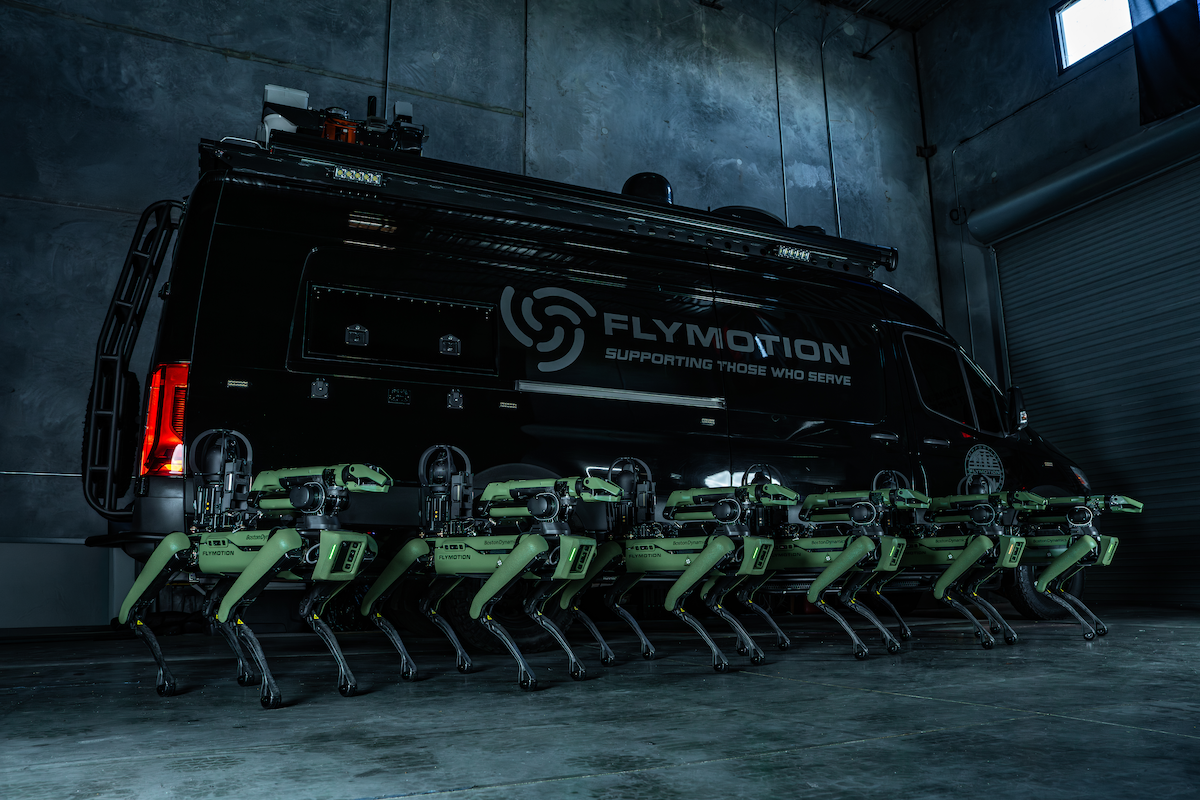

Operational readiness starts long before deployment. That principle guided every phase of FLYMOTION’s recent partnership with a federal agency, from requirements development through live demonstrations, procurement, and full system integration of six quadruped robotic platforms.
Each robot was ruggedized for mission durability and customized to precise agency color and operational specifications. Every system was fielded with FLYMOTION’s Ridgeback 2 payload, the Radio Deployment Kit (RDK), and the Tactical Deployment Kit (TDK), providing a scalable, interoperable ground robotics capability engineered for real-world federal operations.
What sets this deployment apart is FLYMOTION’s ability to deliver a complete, mission-ready payload ecosystem built around the needs of the end user. Each payload was engineered from the ground up to solve specific operational challenges — not adapted, sourced, or rebranded. Every system in this order was configured with the full suite: Ridgeback 2 for command and control, RDK for communications extension, and the TDK for remote non-lethal deployment and explosive breaching.
These are not third-party accessories bolted onto a platform. FLYMOTION’s payloads are purpose-built solutions engineered for interoperability, security, and operational performance across ground robotic systems.

At the core of each integrated system is FLYMOTION’s Ridgeback 2 payload, powered by Silvus Technologies MANET radios. This communications payload delivers a secure, encrypted Mobile Ad-hoc Network (MANET) architecture that serves as the command-and-control backbone across all deployed robotic platforms.
The resilient mesh network ensures persistent connectivity, coordinated maneuverability, and reliable data transport, even in contested, degraded, or communications-denied environments. For federal agencies operating in dynamic scenarios where traditional communication infrastructure may be compromised, this encrypted mesh network capability is mission-critical.
FLYMOTION’s Radio Deployment Kit (RDK) extends secure MANET communications into obstructed and RF-challenged spaces where traditional signals fail to penetrate. This capability enables operators to maintain situational awareness and command authority in environments that would otherwise create dangerous communication gaps.
By deploying mesh network nodes via quadruped robots, federal agencies gain the ability to establish communication infrastructure on-demand, extending their operational reach without exposing personnel to unnecessary risk.
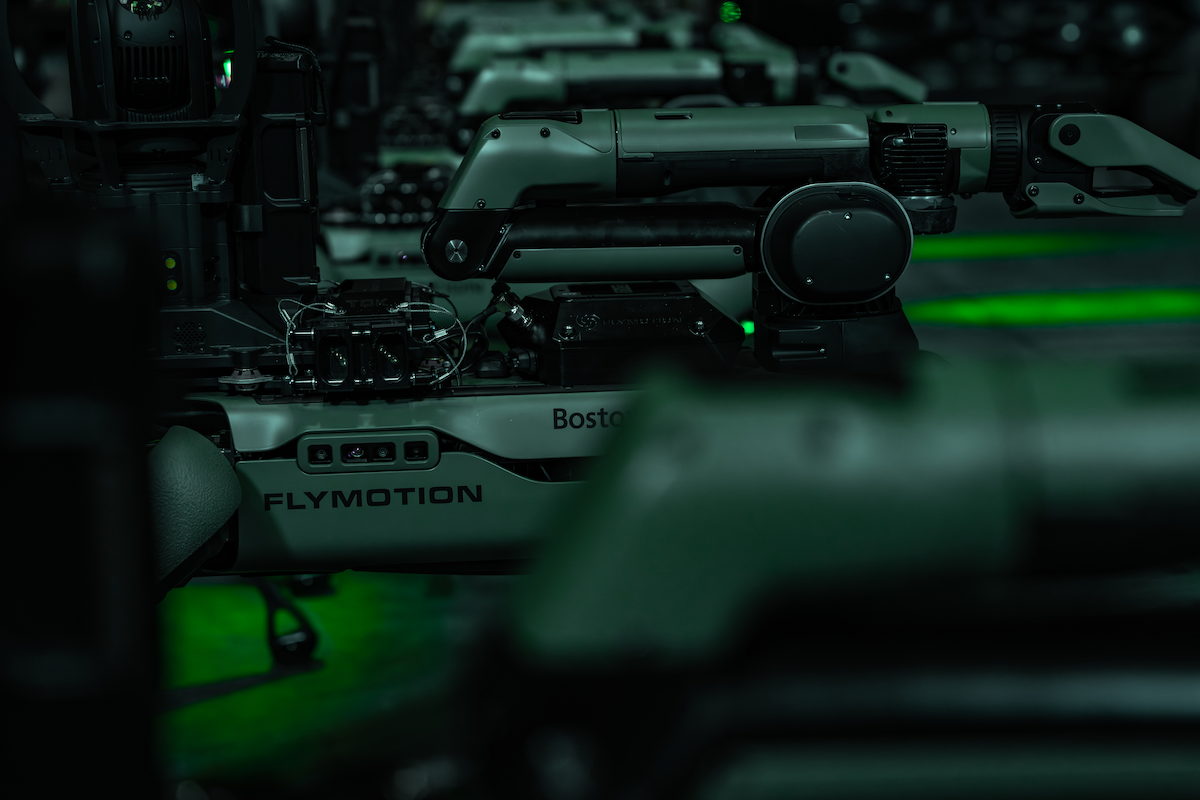
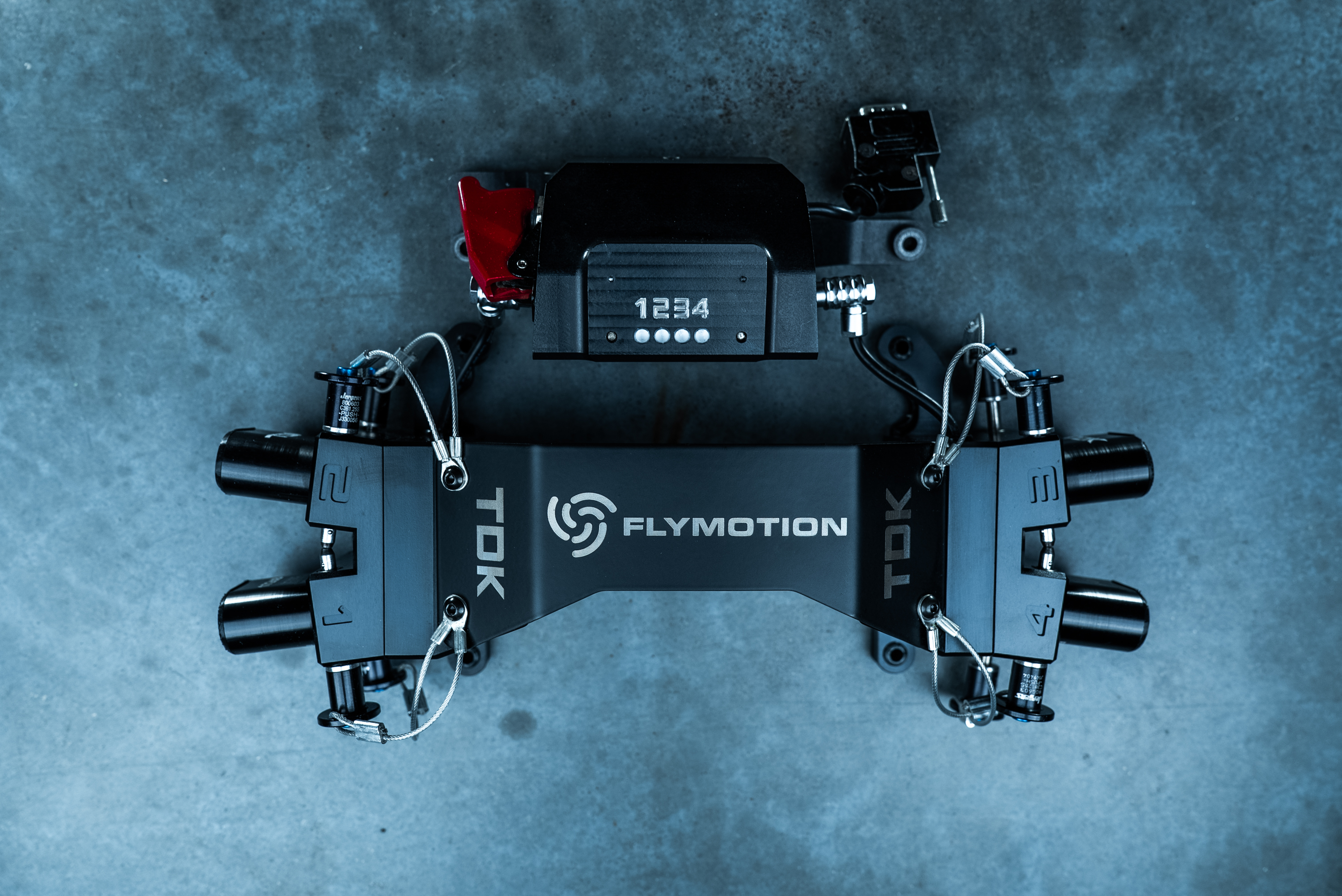
FLYMOTION’s patent-pending Tactical Deployment Kit (TDK) represents a significant advancement in how tactical teams address high-risk scenarios. The TDK is a multi-platform, non-lethal payload system that enables remote deployment of tactical munitions through unmanned platforms, keeping operators at a safe distance during critical operations.
The system supports 7 non-lethal payload options, including sound diversions, chemical agents (OC, PAVA, CS), and training devices, with rapid-reload capability and remotely triggered deployment across multiple mission cycles. Dual-layer safety mechanisms combine mechanical safeties with Electronic Safe, Arm and Detonation (ESAD) protocols, ensuring secure operation and preventing accidental deployment.
The TDK integrates with FLYMOTION’s Ridgeback 2 system and is compatible with existing PTZ cameras and ISR payloads, allowing tactical teams to maintain full situational awareness while deploying non-lethal capabilities. For federal agencies responding to barricaded suspects, hostage situations, or high-risk entries, the TDK provides a critical tool for de-escalation and force protection without direct operator exposure.
Beyond non-lethal munitions deployment, the TDK supports explosive breaching operations through advanced remote initiation — enabling forced entry without operator exposure at the point of breach.
Designed with a modular architecture, the TDK is engineered for integration across multiple unmanned platforms, not just quadruped robots. The TDK is already integrated across a range of platforms — UGVs, UAS, vehicles, and remote systems — ensuring agencies can leverage tactical deployment capabilities regardless of their existing robotic assets.
This deployment represents more than equipment delivery. FLYMOTION partnered with this federal agency from the earliest stages of requirements development through live capability demonstrations, procurement support, and complete system integration.
From comprehensive operator training to mission configuration and field validation, every phase was executed with one objective: deliver an integrated robotics capability that performs when it matters most.
Delivery is just the beginning. FLYMOTION provides 24/7 technical support and sustainment services to ensure these robotic systems remain operational, reliable, and mission-ready. Our commitment to supporting those who serve extends throughout the entire lifecycle of every system we deploy.
FLYMOTION understands that mission success depends on integrated systems that work seamlessly from day one.
FLYMOTION delivers fully integrated robotic and unmanned systems configured to end-user requirements, supported by around-the-clock technical backing, and ready for immediate deployment.
For capability briefings, federal procurement support, or to discuss how FLYMOTION can integrate unmanned systems and tactical payloads for your agency’s operational requirements, contact our team directly.
When the mission can’t wait, FLYMOTION delivers.


Sales, training & support for drones, robotics & technology.



.jpg)